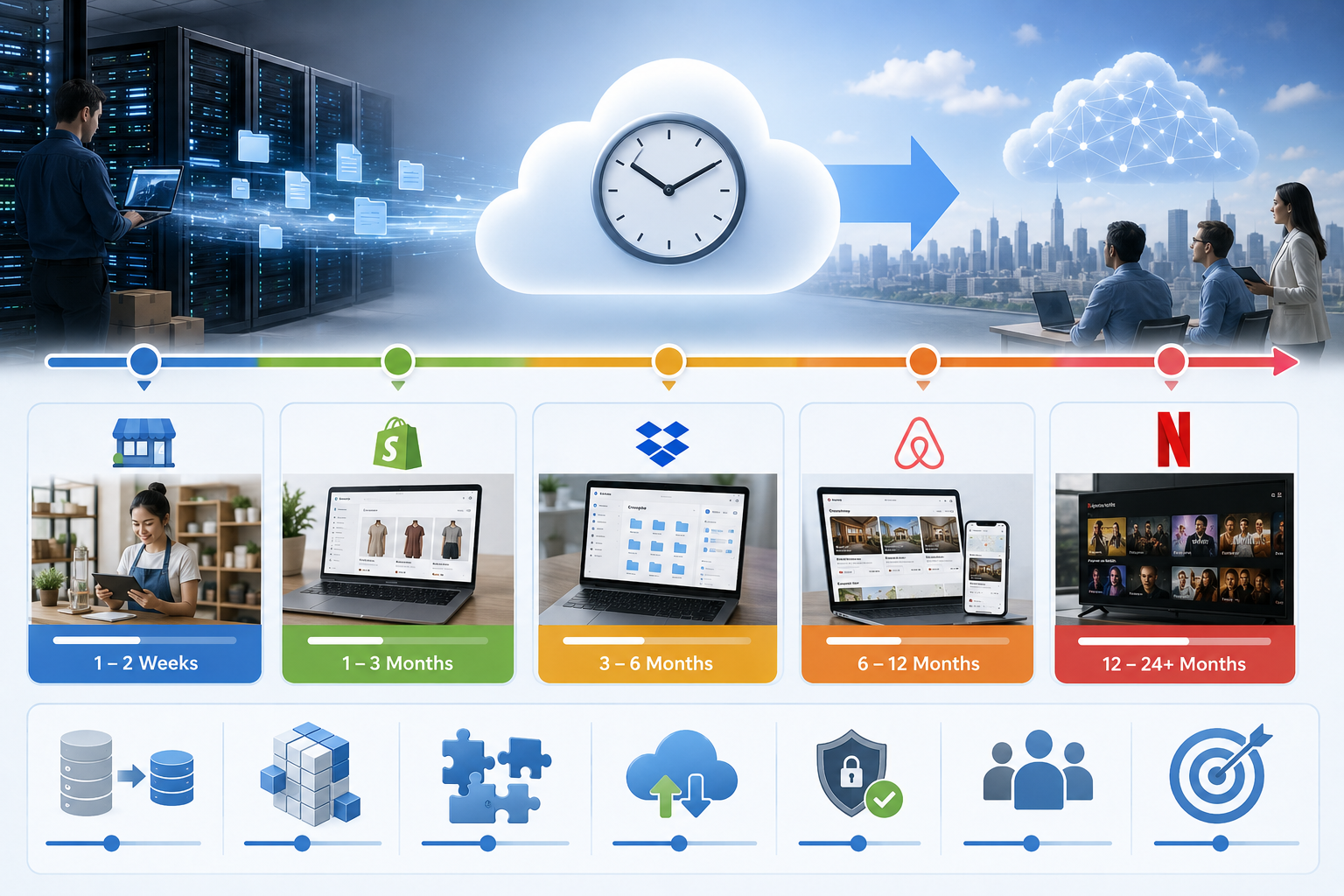
When a CTO and/or a business owner have decided to move to the cloud, it is usually the first question they ask. They want an even number – six months, one year, two. Yet as we all know, cloud migration is not an event but a journey and it really depends on where you start from, how far along you are and what your goals are.
To give you an idea of timings, a typical mid-size migration will take between 6 and 24 months. To see where your project might be on that axis, we must examine some of the moving pieces and reality.
How Long Does Cloud Migration Take?
It is important to understand the “Big Three” factors that save time before we get into examples:
- The Migration Strategy (The 6 R’s): A “Rehosting” (Lift and Shift) project is significantly less time-consuming than a “Refactoring” project which rewrites code for cloud-native use.
- Data Size and Complexity: It is one thing to move ten terabytes of simple files. It is another challenge entirely to migrate to a large, entangled legacy database that has not been cleaned in a decade.
- Compliance and Security: If you are in the healthcare or finance space, naturally auditing and security configuration phases will elongate your timeline.
Real-World Cloud Migration Examples
Modernize your business with secure and scalable cloud transformation solutions.

Example 1: The Quick Win with a Lift Shift
Estimated Time: 3 to 5 Months
An example: A mid-tier 50-server retail company chose to move away from an aging on-premises data center. They did not ask for anything that would significantly improve their apps except to provide freedom from the burden of hardware maintenance.
They decided on a Rehosting strategy and things flew. One month of discovery and planning, two months of configuring the landing zone inside AWS, and finally the migration itself took them two months to migrate the virtual machines.
Example two from the Real World: Hybrid Transformation
How Long: 9-15 Months
A regional financial services entity needed to migrate its customers facing portal to the cloud while keeping core sensitive for compliance. Such Hybrid Cloud approaches are static.
Data transferring is not where the bulk of time is spent here; it is continuously. Producing secure low latency tunnels between the cloud and local data center requires heavy unit tests. For example, it will take 4 months just to do architectural design in this case without even having moved a byte.
Ready have you moved to the cloud yet? With no clear roadmap it can want to try to navigate through these timelines by a guessing game. If you are still uncomfortable with the technical challenges or want to ensure your migration does not stop halfway, the team at Pexo it consulting can help. These are Cloud Transformation services that go beyond merely moving files to modernizing your workings, so the cloud works for you and not the other way around. They might shave months off your projected timeline while keeping your data safe and you would be well served to have the discussion with them.
Live Example 3: The Business Company Refactor
Estimated Time: 2+ Years
Think about a global manufacturer with over five hundred applications, most of which are monolithic (legacy software that is connected to everything else). They were not just looking to simply migrate these apps to the cloud but rather refactor them into microservices.
This is a Refactoring project. The migration, for a company of this scale, is done “in waves” They might migrate ten non-mission critical apps in the first six months to get used to the process, then take on the big guns over an additional 18-month period. This is a marathon, not a sprint but hands-down this has the highest ROI as it minimizes operational cost significantly over the long run.
Common Reasons Cloud Migration Gets Delayed
If you want to stay near the shorter side of these timelines, keep an eye on the usual “time-sinks”:
- Inventory Management Failings: Few organizations have real visibility of how many “shadow” apps are running in their basement. Again, I have learned that discovery takes longer than you think.
- Lack of Skills: If your in-house IT team has not previously worked in Azure or AWS, there is a training period that will delay the middle part of the project.
- Data Cleaning: It is a sheer wastage of time and money to plough ahead with the task of moving dirty or redundant data. Manually sorting through what stays and what goes is laborious, time-consuming.
Key Takeaway
Without exposing yourself to downtime (or security holes), you cannot fast-track a migration. However, you can optimize it.
Begin with a Cloud Readiness Assessment Knowing exactly what you have and picking the ideal migration path (Rehost vs. Refactor) puts a realistic deadline on your shoulders. 5 months or 25 months, it does not matter either way, you want nothing but a stable and scalable environment that lets your business scale.