
The digital world, digital-first world, requires stable and reliable IT systems to make the companies efficient. All these aspects are significant to the smooth running since the network connectivity initiates data storage. It is in this area that IT infrastructure management would be needed. It assists organisations to maintain, monitor, and optimize their IT environment to facilitate expansion, security, and performance.
What is IT Infrastructure Management?
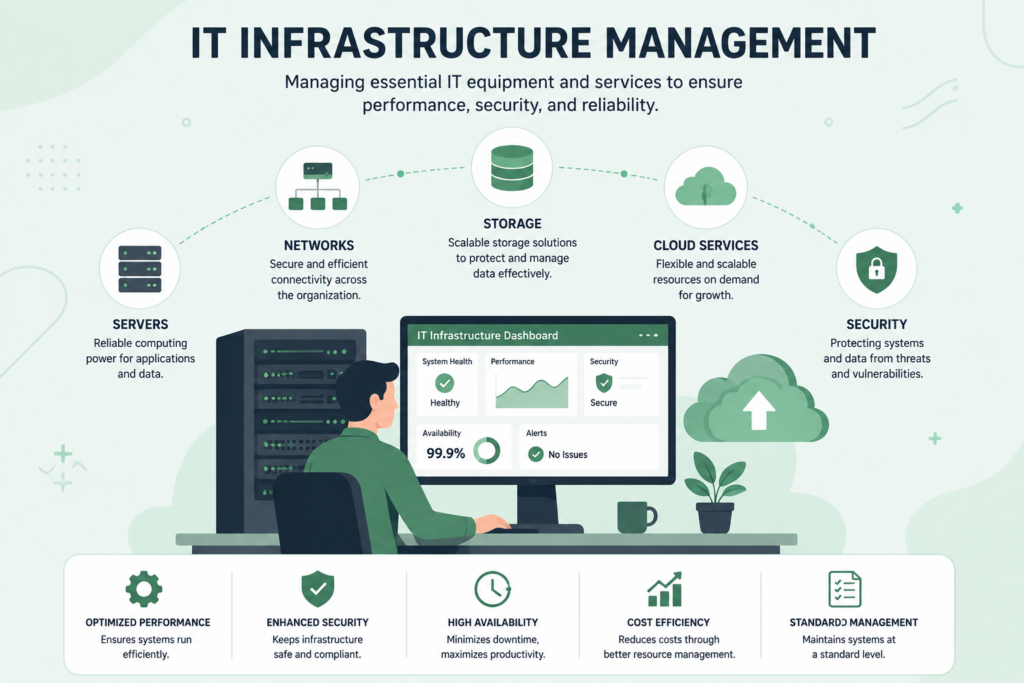
IT infrastructure management is the use and control of essential IT equipment, such as servers, networks, storage, and cloud services. It helps see that the entire system is operating correctly, is kept in a secure condition, and is performing at a standard level.
Core Components of IT Infrastructure Management
1. Server and Storage Management
It covers the aspects of installing, managing, and enhancing the performance of servers and storage units. These are the foundational tools for businesses in handling and storing their data.
Example:
When a firm opts for virtual servers, it benefits from high availability, as this results in load balancing across different machines, reducing system downtime.
2. Management of Network infrastructure.
This is all concerning designing, launching, and operating secure networking equipment in facilitating easy and secure communication between a number of systems.
Example:
To guarantee successful high-speed networking across all locations of the stores, the retail chain has customized its new branch offices with the new versions of firewalls and routers to ensure that the network is safe.
3. Cloud Infrastructure Management.
There is an emerging trend that is viewing the cloud as a platform to operate business processes, cases such as Azure cloud or Google cloud are being brought into the limelight, and therefore, the management of these cloud operations is now of vital concern.
Example:
One of the startups has fully transitioned to cloud operation mode, and as a result, its employees can remotely access systems, and the company can cut its spending on hardware.
4. Data Systems: Data Backup and Data Protection.
This activity is aimed at securing business data and being able to recover it anytime and preventing it from different cyber threats.
Example:
A financial company has the use of an automated backup infrastructure in which it could restore its information within a few seconds of a system hit or a cyberattack.
5. Watching and managing Performance.
By doing constant monitoring, flaws will be detected, and the most effective solutions can be formulated to have the best system performance.
Example:
The AI-based monitoring tools will alert IT staff members about their unrecognized operations or their performance decline to ensure that they take proactive measures to avert the development of significant issues.
Key Benefits of IT Infrastructure Management
1. Server and Storage Management.
These refer to setting up the servers and storage hardware, managing them, and making them efficient. Businesses leverage these systems to handle and store their data.
Example:
By building and deploying virtual servers, a company can have high availability, as the load sharing between servers drastically reduces system downtime.
2. Network Infrastructure Management.
Network infrastructure management mainly involves the design, installation, and maintenance of network security and communication controls, which support the easy transfer of information between systems.
Example:
When the retail chain’s branches are connected, they employ firewalls and secure routers to guarantee security and high speed.
3. Cloud Infrastructure Management.
Business management of cloud infrastructure is an essential part as more and more businesses migrate their operations to cloud environments such as Azure or Google Cloud.
Example:
The startup relocates its operations to the cloud so that its staff can access the systems from anywhere, and at the same time, the company will save on the cost of hardware.
4. FP Systems and Data Protection.
The purpose of this is to guarantee the security of business data, making sure that information is recoverable, and avoiding cyber threats.
Example:
By leveraging automated backup solutions, a bank can be very confident in getting back its real-time data in case the system crashes or it experiences a cyberattack.
Real-World Examples of IT Infrastructure Management
Example 1: E-Commerce Platform
The online store uses cloud infrastructure and load balancing to handle heavy traffic during sale periods. This would make the site responsive and fast, even in high seasons.
Example 2: Healthcare Industry
The secure IT infrastructure in hospitals helps manage patient records, ensuring data privacy and regulatory compliance.
Example 3: Financial Services
Banks have implemented robust security measures, such as backups and safeguards for customer information, to maintain uninterrupted service.
Example 4: Manufacturing Industry
The network infrastructure and IoT systems deployed in factories enable real-time tracking of production processes, increasing efficiency and reducing downtime.
Infrastructure Management Workflow
The performance and security are consistently ensured by a structured workflow. The general procedure consists of:
- Documenting all IT assets
- Identifying security gaps
- Adoption of protection strategies.
- Surveillance systems are in place
- Performance optimisation on a regular basis.
This cyclical process will ensure a stable and secure IT environment.
Conclusion
The current running of the business depends on the IT infrastructure management. Whether the focus is on ensuring system performance or safeguarding data and thus scaling, it is a significant ingredient in the organisation’s success. With established management guidelines and professional assistance, companies can create a safe, productive, and technology-oriented IT infrastructure