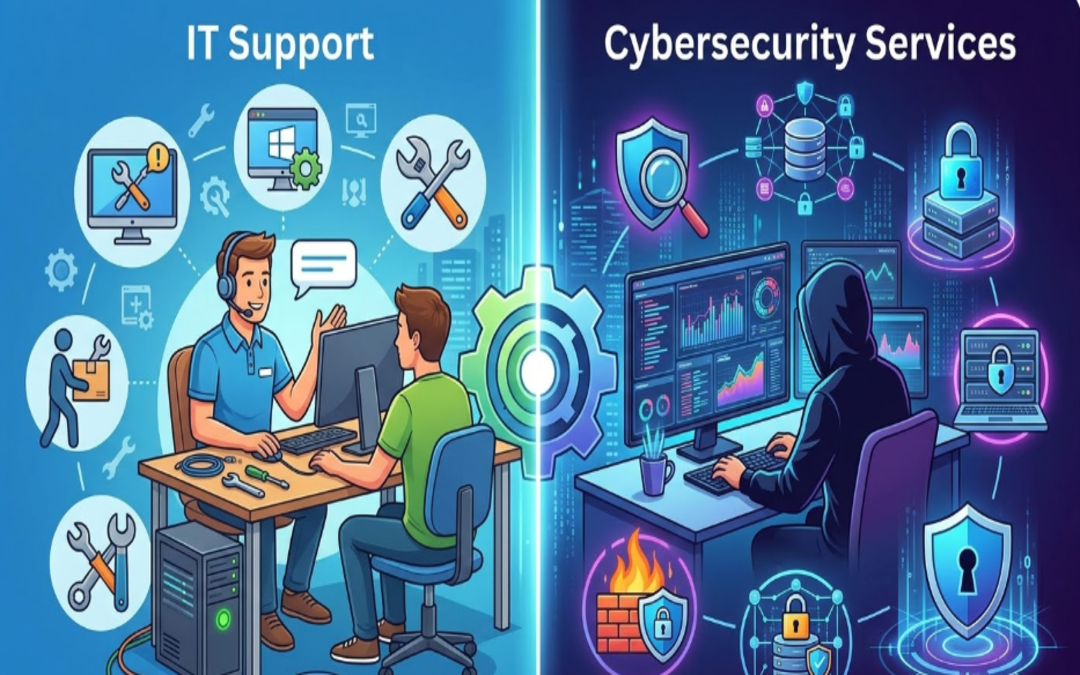
In a digital-first business environment, technology is deeply embedded in how organizations store data, run their operations, and communicate with customers. Hence, IT Support and Cybersecurity Services have become two services that every business, regardless of size, requires. Although these terms are used side-by-side, they have different goals and offer separate pieces to an organization’s tech puzzle.
The distinctions between IT support and cybersecurity services can help businesses make informed decisions, allocate resources efficiently, and strength their overall IT ecosystem.
What Is IT Support?
IT support is a variety of services that assist in maintaining and troubleshooting an organization’s technology systems. The main purpose of IT support is to maintain the smooth and effective operation of all hardware, software and networks.
IT support teams take care of daily technical challenges like:
• Repairing software bugs and system mistakes
• Installing and configuring computer systems
• Managing networks and connectivity
• Installing updates and patches
• Providing helpdesk support to employees
These services are vital to help minimize downtime and keep employees productive. That is entirely up to the organization, as IT support can be in-house or outsourced to managed service providers.
What Are Cybersecurity Services?
Cybersecurity services primarily deal with securing an organization’s systems, networks, and data from cyber threats like hacking, malware, phishing or ransomware attacks. The main purpose is to protect sensitive information and restrict unauthorized access.
Cybersecurity is a proactive defensive position that involves:
• Monitoring systems for suspicious activity
• Firewall | Intrusion detection system
• Vulnerability assessment and penetration testing
• Handling encryption and access policies
• Managing and recovering from security incidents
With the increasing sophistication of cyber threats, cybersecurity services are vital in building trust, compliance and ensuring business continuity.
The Key Differences between IT Support and Cybersecurity Services
While IT support and cybersecurity services are closely linked, there are significant focus differences in their approach and responsibilities.
Purpose and Focus
IT support is concerned with the performance of systems, providing solutions to end-user technical problems. It guarantees the functioning and efficacy of all IT systems.
In contrast, cybersecurity aims to safeguard systems and data from various threats. Its purpose is to avert breaches and risk.
Reactive vs. Proactive Approach
IT support is also typically reactive — it clicks in when things go wrong, like a system crash or a connectivity issue.
Cybersecurity is mostly preventative — it finds weaknesses and puts protections in place to stop attacks before they occur.
Scope of Work
Media coverage and the support provided by IT services have evolved, starting from technical aspects to hardware set-up, software installation, and user-related devices.
Cybersecurity services, on the other hand, are more specialized and focused solely on risk management, threat detection, and data protection.
Skill Sets Required
IT Support staff are usually well-versed in system administration, networking, and troubleshooting.
Specialized knowledge is necessary in fields like ethical hacking, encryption, risk assessment, and compliance standards for cybersecurity specialists.
Why Businesses Need Both
IT support and cybersecurity should not be considered mutually exclusive — the two fields work together. An organisation could boast great IT support but no cyber security infrastructure in place, opening itself up to being hacked. On the same vein, robust cybersecurity may result in operational inefficiencies without dependably timed IT assistance.
They work together to provide a balanced and secure IT ecosystem ensuring systems operate seamlessly while safeguarding data.
How to Choose the Right IT Support Partner
However, businesses that want to work smarter while achieving strong protection and ownership should engage a reputable IT service provider. IT services like IT Support by Pexo use not just technical expertise but also proactive management to ensure that systems work together seamlessly. Organizations that utilize professional IT support can expect less downtime, greater productivity, and a solid foundation upon which other elements (such as cybersecurity) can be built.
Why IT Support and Cybersecurity Go Hand in Hand
In a contemporary business, IT support and cybersecurity teams frequently work in close collaboration. For example:
• Those IT support who manage systems regularly ensure that security patches and updates are deployed, assisting in eliminating security vulnerabilities
• Cybersecurity teams define policies implemented by IT support
• Both teams collaborate during incident response and recovery
This partnership assures that enterprises are not merely operational but bolstered from evolving digital threats.
When to Invest in Cybersecurity?
If the businesses facing this issue fall into these categories, they need to prioritize cybersecurity services:
• Manage sensitive customer or financial information
• Operate in regulated industries
• Adopt cloud systems and remote work environments
• Have experienced previous cyber incidents
By investing in cybersecurity from the get-go, a company can avoid costly breaches and protect its reputation.
Conclusion
Though IT support and cyber security services work toward different goals, they are both critical elements of a modern business strategy. IT support keeps the systems up and running, while cybersecurity secures those systems against threats and vulnerabilities.
Grasping the disparity between the two and appreciating their significance enables enterprises to develop a holistic IT strategy that facilitates growth, enhances productivity, and secures critical assets.


