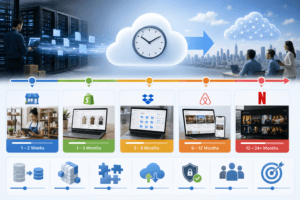
In today’s world, businesses require flexible, secure and easily managed technology. Enterprise cloud IT infrastructure allows companies to store their data, run programs and allow workers to work anywhere. It also lowers hardware expenditure and eases growth as your company progresses.
There must be planning for migrating to the cloud. The correct installation maximizes the performance, security and reliability. We will talk about the 5 most popular methods of setting up your cloud IT infrastructure.
5 Smart Ways to Build Your Cloud IT Infrastructure

1. Select the proper Cloud Model.
The first step is selecting the type of cloud to fit your business. It could be done in three principal ways;
● Public Cloud : It can be a cheaper alternative, although it will be sharing the cloud resources with other clients.
● Private Cloud: It has resources that you can utilize solely to gain further security and control.
● Hybrid Cloud: Dynamically combines Public and Private Cloud.
The open cloud is a cheap option for small businesses. Enterprises with stringent security or compliance issues may have the best use of private or hybrid cloud.
| Cloud Model | Best For | Main Benefit |
| Public Cloud | Small and medium-sized businesses | Low cost and easy to scale |
| Private Cloud | Businesses with strict security needs | Greater control and enhanced security |
| Hybrid Cloud | Growing businesses with mixed workloads | Flexibility to use both public and private environments |
2. Assess Your Existing IT Environment
Evaluate the current IT environment prior to cloud migration. Determine the workloads, databases, and applications to migrate.
Make inquiries like:
- What business critical applications do you have?
- What is the storage that you currently use?
- What systems do you need high availability for?
- Are there any applications that are outmoded and have to be removed?
The correct assessment will prevent you from incurring any additional costs, and the moving steps will go more smoothly.
3. Invest in Good Security from the Start
Securing the environment is important and must be accounted for at the beginning of the process to move to the cloud. It’s critical to protect your business data.
Some of the key security issues are:
- Employ multi-factor authentication (MFA)
- Encrypt sensitive data
- Identify proper password practices
- Keep software updated
- Set user access based on user job role
- Monitor clouds on a frequent basis.
Further, with regular backups and disaster recovery plans, downtimes are minimized in case of unforeseen problems.
4. Selection of trusted cloud solutions
A cloud infrastructure is based on the services that you select. Search and find a solution that has good customer support, reliability, and scalability.
Take into consideration the following aspects:
- System uptime
- Data backup options
- Security certifications
- Easily integrates with the existing software.
- Technical support availability
- Pricing and scalability in the future.
By making the right decision to rely on the services of a trustworthy cloud, you will be able not only to run your business without any inconveniences but also to help your business develop in the future.
5. Monitor, Optimise and Scale
Building your cloud infrastructure is only one aspect. Active watchful waiting ensures your systems are maintained at an effective performance.
Monitor key areas, such as:
- Server performance
- Storage usage
- Network traffic
- Cloud costs
- Security alerts
As your business expands, add storage and computing capacity and new cloud-based services without having to purchase costly hardware. One of the major benefits of cloud infrastructure is this adaptability.
Why Choose Pexo for Cloud Transformation?
Cloud transition is not an easy path to undertake without the proper assistance. With minimal disruption, Pexo’s Cloud Transformation Service helps businesses plan, migrate and optimise their cloud environment. From upgrading to the latest technology to building a new cloud site from the ground up, Pexo provides solutions that can be customized to meet the needs of each business to improve their performance, security and efficiency.
Advantages of a Well-Planned Cloud IT Infrastructure
In the long term, a well-designed cloud infrastructure offers the following opportunities:
- Lower the costs of IT infrastructure investments
- Better business continuity
- Improved data security
- A user can log in remotely and easily.
- Reduce deployment time for new applications
- Scalability to adjust to different business requirements.
- Reduce storage and maintenance of physical servers.
These benefits empower organizations to invest more in building their businesses and less in IT maintenance.
Conclusion
Cloud IT infrastructure provides flexibility, security and performance that are required by today’s digital world. With the right cloud model, evaluation of current systems, enhanced security, reliable cloud services and constant evaluation of your environment, you can establish a cloud infrastructure that will set you up for success.